The Maryland institute of technology in the humanities’ (MITH) vintage computers is a digital archive which is solely dedicated to preserving and documenting the history of technology and computers. As someone who has a dad whose job revolves around computers he and have been told stories about just how large these computers used to be, this website particularly interested me because of that reason.
This site essentially is an online history museum of the subject of technological development. It’s a database that documents computers as a complex system of interconnected components such as software and other materials.
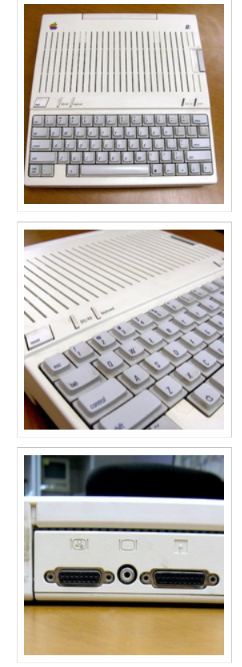
This project was launched in 2010 and was created using Omeka, a content management system designed for scholarly projects. Interestingly, MITH states the purpose of the project was to not just simply display old vintage computers to the viewer but to demonstrate a model for preserving and documenting these digital artifacts. It works as a great resource for discovering facts you don’t know about like how this old technology was operated and used.
The content on this site consists of a collection of vintage computers, retro-software and other artifacts. As someone who is obsessed with old technology to the point this summer I went to a video game convention that demonstrates this old technology, this site particularly fascinated me.
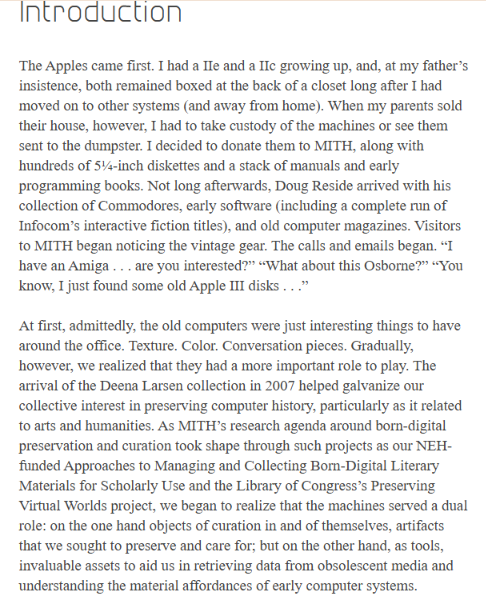
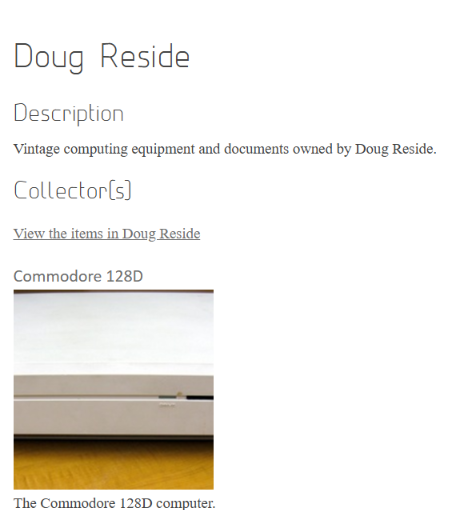
This site is similar but entirely able to be explored through digital means. This collection of technology they state was primarily started by donated apple 2 computers and further expanded though other donations which included but not limited to commodore computers, computer magazines and materials from the Deena Larson collection.
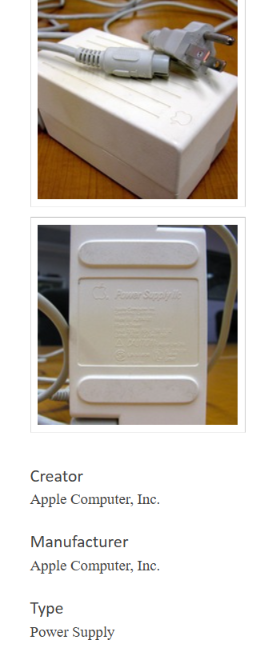
What’s really interesting is that this old technology serves a dual purpose, the introduction states that this technology serves both useful as historical artifacts and discovering obsolete or lost media stored on them.
This is something that should be important to everyone as preserving our media is preserving our history which of course gives the website meaning beyond purely nostalgia.
The site medium and structure is very important to it achieving its purpose, “Vintage computers” is primarily a digital database and archive of sorts but through tabs it functions as an online exhibit for certain topics.
One of its most important features is its system of relational browsing. MITH specifically describes “hierarchical component browsing” as a central feature to their website and it’s certainly what the whole site revolves around. The user can navigate through tags such as “video card” and “motherboard”. This can be seen clearly in sections such as the record for the “apple IIe motherboard”.
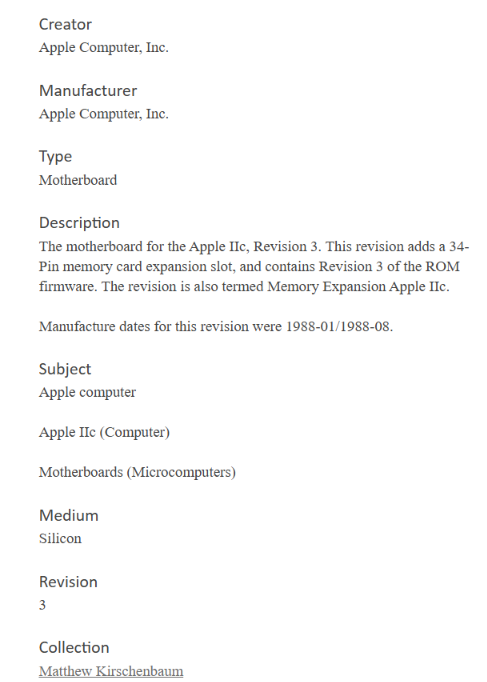
This page does not simply provide a photo with a short description but also identifies the motherboard as revision B model, provides a serial number, it’s part number, identifies its placement in the collection and connects it to other objects in its history. By using the tag system the user now knows that the motherboard is related to the applesoft 2 BASIC and the MOS 6502 microprocessor, while its “sister parts” include a hayes micromodem 2, ramworks, a wild 2 grappler + printer interface, kensington microware system saver, an astec power supply and disk 2 drive controller card. All this information about the technology is easily accessible to both novices and experts alike through an easy to manage system of tags.
This organized structure makes this project very suitable for the digital medium. A museum or exhibition can provide the object physically with text at the bottom but through the digital medium and websites format it turns the technology it demonstrates into a web of connected information waiting to be explored.
This is incredibly useful because not only is it a digital museum available at the user’s fingertips at any time but it also provides something extra in terms of exploring history. As media is becoming more and more digital a site like this is very useful for documenting the history of technology and preserving it for future generations. A user can start from the computer itself, then move to the motherboard, from the processor to related software.
For example, the MOS 6502 record as a processor identifies as a 8-bit microprocessor for the apple 2e, gives its speed of processing which is 1.023 MHZ, provides the serial and part numbers, provides both serial as well as part numbers and connects it all back to the apple IIe motherboard. Users may find facts like that the apple 2 BASIC record similarly identifies with many other apple 2 computers and devices.
Although, new users may not understand how the relationships between the objects work, experts will relish the relationship between pages with the large amounts of technical information. The finer aspects of the site definitely require a bit of knowledge in the subject. The site’s target audience appears to be researchers, historians and people highly interested in the topic of vintage computers, basically experts get the most out of this site.
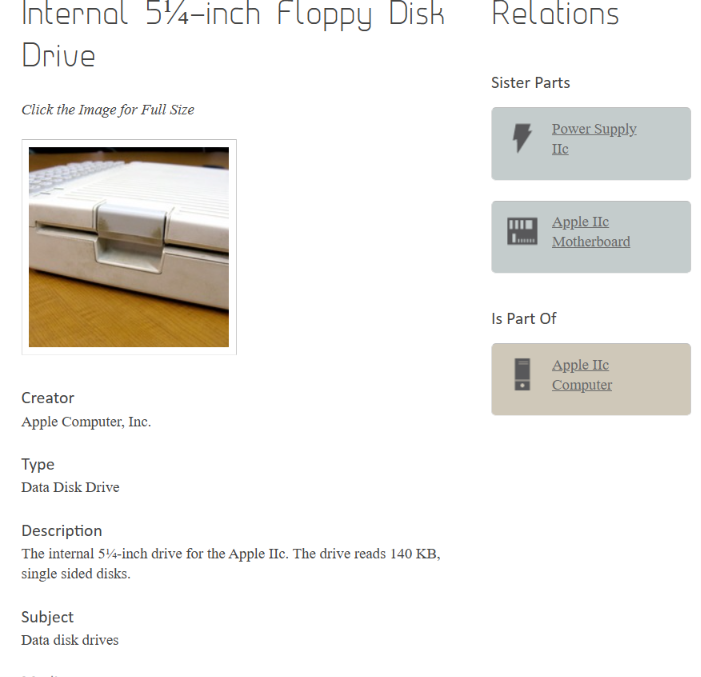
The site’s metadata is particularly useful for scholarly research and people studying obsolete technologies. An example of this is the “FC5025 USB 5.25-inch Floppy Controller”, which has an operation guide and documentation that is associated with it. The device identifies as a 34-pin dual role header and USB type B connector. What this illustrates is that the project is interested in recovering old obsolete storage formats for intrigue as well as showing the history for the objects to the user.
The visual design of this site definitely serves to be more functional than decorative. There is a huge emphasis on photos, large amounts of text, metadata and especially tags than elaborate visual effects or animations that catch the user’s eye. This approach is appropriate for a site that values research because all the attention is put on the objects and their documentation. The simple minimalistic approach can be considered a strength because it doesn’t clash with the information being put out about the technology.
When evaluated using the 10 principles of Dietar ram of good design, several principals apply very well. First, the website makes the collection innovative by turning physical objects into a web of resources using tags. Second, it attempts to make the technology understandable for both experts and new users alike. It has a minimalistic aesthetic rather than an overstimulating mess.
It is thorough down to the last detail which is one of its strongest points of good design, the Apple IIe motherboard is a particularly strong example of this . It is long lasting as it covers an entire product’s history. Good design should be honest, MITH states that their site is not yet a full comprehensive inventory of every vintage computer in their collections.
This not only shows honesty but demonstrates that there is plenty more information to be put on the site in the future which encourages future visits. This is also important because the site does not pretend to represent the entire history of computing, only certain individual artifacts in their collection.
Overall, the sites focus on usefulness and clarity and do a fine job at executing principals for good design. It doesn’t need to be visually spectacular to get the job done. It uses its database to create a web of information that explores the relation of historical artifacts.
It uses the medium of a website to its advantage through the use of tags and can be regularly updated, something that a book can’t do. It explores the relation between objects dynamically rather than purely individually. MITH “vintage computers” turns a collection of physical artifacts into a navigable network of historical information.
Sources sited:
https://archive.mith.umd.edu/vintage-computers